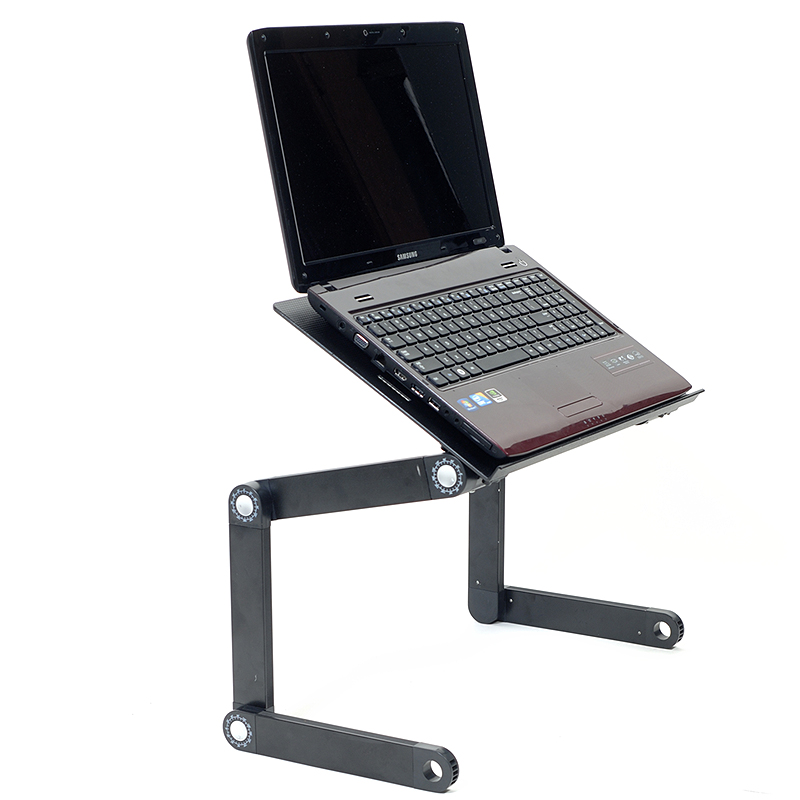
Wish you could use a standing desk occasionally, but don’t want to be bothered with dealing with one all the time? (Studies show that in most cases, people spend a lot of money for a desk that goes up and down – and alter its position twice before giving up.) Uncaged Ergonomics has a nifty, and decently-priced, addition to the office that could be the answer to your prayers.
The Internet is rife with back pain forums – essentially chat rooms where people talk about their conditions, and no one ever seems to get better. These are scary places, and it would be best to stay away from them, unless you’re looking for a pity party. (Forum members typically post an ever-lengthening list of surgical interventions and pharmaceutical cocktails after their names.) There is a great deal of misinformation out there, not to mention desperation. If you visit the forums, do so with a skeptical eye.

One of the better ones is run by the Spine Patient Society. There is also a discussion board at ADR Support, which also addresses artificial disc replacement here.
Pennsylvania

Joe Zarett, whose large facility, Zarett Rehab, is an excellent pick for getting your body back in order. He is incredibly demanding, but can help you implement the major change you need.
Waterloo, Ontario, Canada
Dr. Stuart McGill is a professor of biomechanics at the University of Waterloo in Ontario, Canada. He frequently advises governments, corporations, and elite athletes and athletic teams when it comes to difficult back cases. In his laboratory at the University of Waterloo, experts test out products and recommendations, and only the best make it to his website, BackFitPro, a repository of back pain prevention and rehabilitation information.
Watch this video to get to know McGill and his work a little better:
This video provides a brief introduction to Tai Chi with Dr. Yang, as a sample of what you might find on the full DVD. Tai chi is an extremely popular and very gentle physical way to fight stress and reduce anxiety.
There is also a DVD available for purchase in which Dr. Yang presents gentle exercises to ease lower back pain in the tradition of Qigong (pronounced chee-kung), “the art of using the mind to direct the energy within your body to improve health and vitality.” The DVD serves as an introductory guide for beginners, going over the principal concepts of qigong as well as detailing the exercises.
On this DVD, Dr. Yang presents gentle exercises to ease lower back pain in the tradition of Qigong (pronounced chee-kung), “the art of using the mind to direct the energy within your body to improve health and vitality.” The DVD serves as an introductory guide for beginners, going over the principal concepts of qigong as well as detailing the exercises.

The book Back Care Basics: A Doctor’s Gentle Yoga Program for Back and Neck Pain Relief is a good source to read up on therapeutic yoga as a low-cost solution for back conditions. Author Mary Pullig Schatz emphasizes positivity and dedication in both the prevention and treatment of issues from strain, arthritis, osteoporosis, scoliosis, pregnancy, and stress with yoga.

California
If you’re in southern California and are looking for excellent yoga instruction with a focus on alleviating back pain, seek out classes with Roger Cole at Yoga Del Mar, just north of San Diego. On his website, he also posts workshops that he offers out-of-state throughout the year.

Read Cole’s article posted on the Yoga Journal, titled “Back on Track: 5 Daily Poses to Ease Back Pain“
Watch this video from the American College of Physicians (ACP) and the Annals of Internal Medicine about how yoga can effectively treat chronic low back pain:
Before you decide that the skeleton has limitations, watch some of the incredible things the human body can do in “Duo de Paradis,” in a contemporary French cabaret show.
If you have back pain and an interest in yoga, Iyengar is for you. The website for the Iyengar Yoga National Association of the United States provides information on the Iyengar method as well as histories of its creators and developers (B.K.S. Iyengar is apparently known as the “Michelangelo of yoga”), research on the body and its interaction with yoga, information on Iyengar teacher certification and evaluation, links to books and articles, and a teacher search function. Iyengar yoga aims to adjust poses and practices to the individual, and to teach in stages, starting with standing poses for beginners and moving on from there to more complex poses and flows. Emphasis is on accessibility of yoga to everyone, regardless of age, physical condition, or mental and emotional state. Read an article about how Iyengar views the spine here.
For more information about the benefits of Iyengar yoga for low back pain, read this article published in the International Journal of Yoga Therapy, called “Therapeutic Application of Iyengar Yoga for Healing Chronic Low Back Pain.” And check out Yoga for Healthy Lower Backs, based off of research by the University of York.
California

The American Viniyoga Institute is the union of practitioners and institutions that base their practice in Viniyoga. As the site explains it, Viniyoga is “a comprehensive and authentic transmission of the teachings of yoga including asana, pranayama, bandha, sound, chanting, meditation, personal ritual and study of texts. Viniyoga (prefixes vi and ni plus yoga) is an ancient Sanskrit term that implies differentiation, adaptation, and appropriate application.” Gary Kraftsow developed the institute in order to tailor different methods and practices in yoga to individuals’ specific needs and conditions with a focus on back pain. The institute is based in Oakland, CA, but you can search for a teacher or therapist anywhere through the AVI website’s directory here.
The Alexander Technique is an all-purpose postural approach that aims to help you lose the undesirable or uncomfortable physical habits you have developed in your life. It’s most appropriate for strain or injury, back and neck stiffness, discomfort in sitting and other physical positions, and particularly for professionals in physically-based activities: musicians, athletes, and dancers very often turn to the Alexander Technique to help them perform optimally.
This website explains the method, offers different applications of the method depending on your condition, provides research and endorsement information, and hosts a huge number of links to different practitioners and courses available worldwide. There is also a site specifically dedicated to the Alexander Technique International, which also offers information on a number of books and audiobooks, periodicals, and dissertations on the technique. Search by country or for specific practitioners here.
The following is a two-part video created by the British Medical Journal about the Alexander Technique:
New York
The Feldenkrais Method is a postural approach that, by employing exercises in movement and encouraging the mind to reconnect with the body, helps individuals restore better physical function. Through the website you can search for practitioners and classes across the United States. Courses offered are either part of their “Awareness Through Movement” therapy, in which patients are guided verbally through sequences of motion and exercise, or part of the “Functional Integration” program, in which practitioners guide participants through movements with gentle, non-invasive touching.

You can also find information and excellent course selections at the New York Feldenkrais Institute, which has Feldenkrais superstar Marek Wyszynski on staff – and Wyszynski is also president of another NY-based Feldenkrais institution, Physical Therapy & Feldenkrais NYC.

Watch this video (or watch below) on “How The Nervous System Senses Differences,” presented at the Feldenkrais Institute of New York.
Colorado
The Rolf Institute of Structural Integration is the official institution of the postural approach called “Rolfing,” developed by Ida P. Rolf. Rolf founded the institute in 1971, and it is located in Boulder, CO. Its website offers information on Rolfing as well as a comprehensive catalogue of certified Rolfers through a search function, if you can’t attend classes at the Institute itself in Colorado. (Note: there are more Rolfers than will appear on the RSI site, however; the site displays practitioners who have paid to be advertised there.)

East Midlands, United Kingdom
If the location makes sense for you, consider the RealHealth Institute, located in the East Midlands of the UK, with locations soon to come in London. The institute offers non-surgical treatment options, with an intensive treatment program for the treatment of persistent pain as well as a functional restoration program geared toward recovery from a more specific injury.
New Hampshire
This functional restoration program in Lebanon, NH is provided by the Spine Center of the Dartmouth-Hitchcock network of health programs in northern New England, and led by Dr. Rowland Hazard, one of the leaders in functional restoration. The goal of their rehabilitation program is to limit the need for more spine surgeries and instead help patients develop the tools to return to functional lives at home and work alike.
Massachusetts, Minnesota

The Spine Center at NEBH specializes in evaluation, treatment and management of spine disorders. Dr. James Rainville leads an internationally-recognized exercise-based “boot camp” program.
Here’s a midwestern program based on James Rainville’s protocol.
Read an article featuring Carol Hartigan from the New England Baptist Hospital about hitting the weights.
From a website specifically devoted to Safe Spine Surgery, here is a list of twelve questions you should definitely ask before deciding to undergo invasive treatment.
Here’s a list of red flags meant to let you know whether it’s time to say goodbye to your prospective spine surgeon. (Some warning signs are obvious; many less so.)
